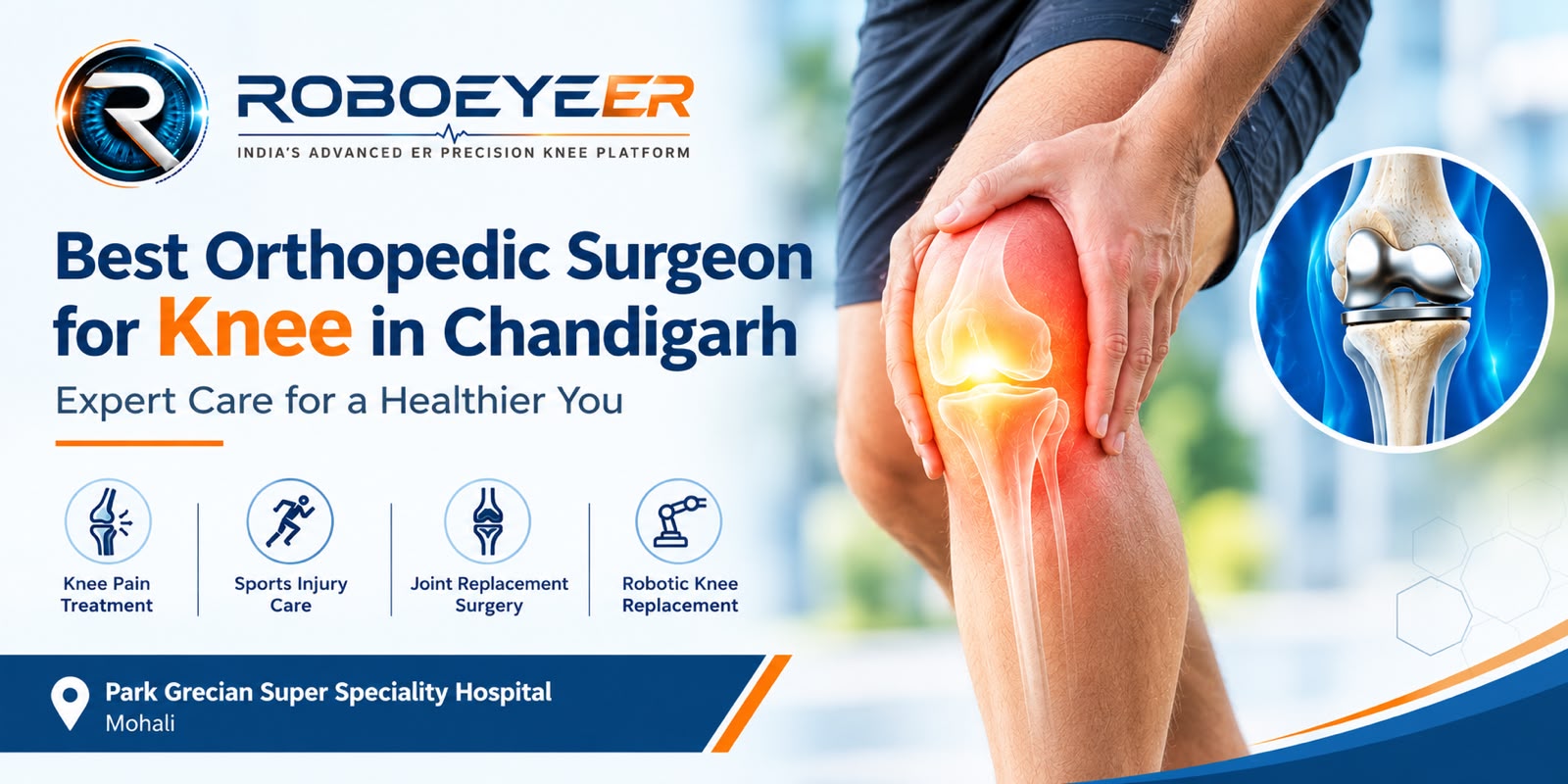
Nearly every aspect of everyday life, including walking, climbing stairs, exercising, working, and obtaining a good night’s sleep, can be impacted by knee discomfort. Persistent pain, swelling, or stiffness may point to an underlying joint issue that requires medical evaluation, even though sporadic discomfort may go away with rest and the right therapy.
Understanding the origin of the pain, the various treatments, and the experience of the specialist are the first steps in choosing the best orthopedic surgeon for knee Chandigarh patients may contact. From advanced arthritis that may necessitate joint replacement to sports injuries and ligament damage, an orthopedic surgeon can assess knee issues.
Orthopedic surgeon chandigarh Dr. Bhanu Pratap Singh Saluja practices sports medicine and joint replacement at Park Grecian Super Specialty Hospital in Mohali. His orthopedic credentials and extra fellowship training in joint replacement are listed in his public hospital profile. Patients from Chandigarh, Mohali, Panchkula, and surrounding places can talk to a trained specialist about their knee problems and look into a suitable course of treatment.
Why Is It Important to Take Care of Your Knees?
One of the body’s main weight-bearing joints is the knee. It consists of cartilage, ligaments, tendons, and other tissues that promote stability and mobility and joins the thigh bone to the shin bone.
These structures may be impacted by injury, aging-related changes, excessive joint stress, and specific medical problems. Ongoing knee issues can limit mobility and make daily tasks more challenging if they are not properly assessed.
Early assessment can assist in determining the source of discomfort and if rehabilitation, medication, lifestyle changes, or surgery should be the main focus of treatment.
Typical Reasons for Knee Pain
1. Osteoarthritis
When a joint’s protecting cartilage gradually deteriorates, osteoarthritis results. It may result in edema, decreased flexibility, stiffness after resting, and pain when moving. Walking and everyday activities might be severely impacted by advanced cases.
2. Damage to Ligaments
Ligaments aid in knee stability. Sports, falls, and abrupt twisting motions can all result in injuries to the anterior cruciate ligament (ACL), posterior cruciate ligament (PCL), or other supporting structures.
Swelling, instability, trouble bearing weight, or a feeling that the knee might give way are some of the symptoms.
3. Tears of the Meniscus
The menisci are cartilage structures that aid in the knee’s weight distribution. Age-related deterioration or a twisting injury might cause a tear. Pain, swelling, catching, or limited movement are experienced by some patients.
4. Joint Disorders, Including Rheumatoid Arthritis
Joint pain, stiffness, and edema can be symptoms of inflammatory diseases such rheumatoid arthritis. Coordinated care including orthopedic and medical doctors may be necessary for certain diseases.
5. Prior Fractures or Injuries
Previous injuries can occasionally result in ongoing pain, instability, or altered joint function. The initial injury and the knee’s current state determine the best course of action.
When Should You See a Chandigarh Orthopedic Surgeon?
If your knee discomfort persists, keeps coming back, or starts interfering with your regular activities, you might think about getting an orthopedic consultation.
Typical justifications for requesting an evaluation include:
- persistent discomfort when standing, walking, or ascending stairs.
- stiffness or swelling that does not go away.
- difficulty straightening or bending the knee.
- many instances of the knee locking or giving way.
- pain that prevents you from sleeping or performing daily duties.
- minimal improvement with the right nonsurgical care.
If you acquire a significantly swollen or malformed knee, have a hot, red joint with a fever, or are unable to bear weight following an injury, get a medical evaluation very once.
How Knee Issues Are Diagnosed by an Orthopedic Surgeon
Before choosing a course of treatment, an accurate diagnosis is crucial. Instead of depending just on symptoms, a specialist usually takes into account a number of criteria.
Physical examination and medical history
The doctor might inquire about the onset of the pain, whether there was an injury, what activities exacerbate the symptoms, and whether you have ever had knee issues.
Movement, swelling, discomfort, joint stability, and walking pattern may all be examined.
Imaging and Additional Research
An X-ray can be used to evaluate osteoarthritis symptoms, bone alterations, and joint-space constriction. When further information on menisci, ligaments, or other soft tissues is required, MRI may be advised.
Not every patient needs to be investigated. Clinical findings and the presumed diagnosis are taken into consideration while choosing tests.
Options for Knee Pain Treatment
The etiology, severity, and impact of the ailment on daily life determine the appropriate course of treatment.
Non-Surgical Therapy
Initially, a lot of knee issues can be treated without surgery. Treatment options may vary based on the diagnosis:
- Physiotherapy helps enhance joint function, strength, and flexibility.
- To lessen irritating movements, alter your activities.
- When necessary, control your weight to lessen knee strain.
- medication that a licensed doctor has prescribed.
- When advised, use assistive technology or walking assistance.
Although their efficacy varies by condition, some interventions may help lessen symptoms and enhance function.
Treatment for Sports Injuries and Arthroscopy
During a minimally invasive treatment called an arthroscopy, a surgeon examines and, if necessary, treats internal joint structures using a tiny camera. For some issues, such as specific sports injuries, it might be suitable.
Nevertheless, not all forms of degenerative knee pain respond well to arthroscopy. A specific procedure should be explained by the surgeon in relation to your diagnosis.
Surgery for Knee Replacement
When severe arthritis or other significant joint deterioration limits function and causes chronic discomfort despite effective nonsurgical therapy, knee replacement may be considered.
Artificial components are used to repair damaged joint surfaces during the process. While total knee replacement treats more significant damage, partial knee replacement may be a possibility when the disease only affects a suitable portion of the joint.
The patient’s anatomy, diagnosis, degree of activity, general health, and clinical evaluation all influence the decision.
Knee Replacement with Robotic Assistance
Specialized technology is used in robotic-assisted knee replacement to help specific areas of surgical planning and execution. Depending on the technology, it could help with surgical guidance, implant placement, or anatomical evaluation.
The surgeon is still in charge of choosing the course of treatment and carrying out the procedure. Not every patient will benefit from robotic technology, thus its appropriateness should be evaluated during consultation.
How to Pick the Top Orthopedic Knee Surgeon in Chandigarh
There is more to selecting an expert than just looking for the newest technology or comparing internet rankings. Seek a physician who can provide a comprehensive explanation of your problem and make treatment recommendations tailored to your specific circumstances.
Before choosing a choice, take these things into account.
Requirements & Applicable Experience
Verify the surgeon’s orthopedic training, credentials, and experience in treating your particular condition. When it comes to joint replacement, inquire about experience with complex cases, revision operations, and complete and partial knee replacement.
MBBS, MS (Orthopaedics), a Fellowship in Joint Replacement in Germany, and FIJR fellowships in the UK, Scotland, and Australia are listed on Dr. Bhanu Pratap Singh Saluja’s official hospital profile. Sports injuries, joint replacement, and robotic hip and knee surgery are among his stated areas of specialization.
Unambiguous Communication
The diagnosis, available treatments, possible hazards, anticipated recovery, and any uncertainties should all be covered in a quality consultation. You must to get the chance to learn why a certain choice is advised and ask questions.
Rehabilitation and Monitoring
Physiotherapy, exercise, and follow-up consultations are often necessary for recovery. Ask about postoperative care and rehabilitation support before selecting a treatment facility.
Open and Honest Treatment Planning
Ask for a detailed description of the suggested process and related expenses. Inquire about hospitalization, implant alternatives, medicine, physiotherapy, and follow-up costs if surgery is advised.
What to anticipate following knee surgery
The operation, the patient’s overall health, muscle strength, and the severity of the initial issue all affect recovery.
When it is medically appropriate, many people who have had knee replacements start moving under supervision shortly after the procedure. Physiotherapy strengthens supporting muscles, increases range of motion, and progressively restores walking capacity.
Observe the surgical team’s directions for medication, walking assistance, activity limitations, and wound care. Don’t start intense activity right away without a doctor’s approval.
If you notice unusual swelling, fever, severe pain, or rising wound redness, get medical help right once. Emergency medical care is necessary if you have sudden dyspnea or chest pain.
FAQ
1. How can I locate the top orthopedic specialist in Chandigarh for knee surgery?
Seek out an orthopedic specialist who is qualified, has relevant experience with your problem, communicates clearly, offers evidence-based treatment recommendations, and has access to suitable rehabilitation programs.
2. When is surgery necessary for knee pain?
When a particular structural issue necessitates surgical intervention or when severe joint damage persists despite receiving the proper nonsurgical treatments, surgery may be taken into consideration. Not every knee ailment necessitates surgery.
3. Is a robotic knee replacement superior than a traditional one?
The patient, the surgical system, and the clinical setting all influence the response. While robotic aid can help with planning or direction in some operations, it does not ensure better results for all users.
4. Is it possible for knee arthritis to go better without surgery?
Exercise-based physical therapy, activity moderation, the right medication, and, if necessary, weight control can all help alleviate symptoms. Although extensive cartilage loss cannot be stopped by these treatments, some individuals may be able to control their symptoms and continue to function.
5. What examinations are required for knee pain?
A physical examination and medical history are typically crucial first steps. Depending on the suspected reason, an MRI or X-ray may be advised. Each patient has different tests that are necessary.
6. How long does it take to recover from a knee replacement?
Everybody recovers differently. While strength, mobility, and confidence may continue to improve over several months, many patients achieve slow progress over a few weeks. Observe the recovery regimen prescribed by your surgeon.
Conclusion
Knee pain should not be ignored when it begins to interfere with movement, sleep, or everyday activities. Early assessment can help identify the underlying problem and determine whether physiotherapy, medication, lifestyle changes, or surgery may be appropriate.
If you are searching for the best orthopedic surgeon for knee Chandigarh or an experienced orthopedic surgeon Chandigarh patients can consult for joint-related concerns, focus on qualifications, relevant expertise, personalised treatment planning, and rehabilitation support.
NAP Information and Contact Details
Doctor: Dr. Bhanu Pratap Singh Saluja
Speciality: Orthopaedics, Joint Replacement and Sports Medicine
Hospital: Park Grecian Super Speciality Hospital
Address: Jail Road, Phase 9, Sector 69, Sahibzada Ajit Singh Nagar, Mohali, Punjab 160062, India
Contact number: +91 83310 00038
SOCIAL MEDIA
Facebook:https://www.facebook.com/Dr.BhanuPratapSinghSaluja
Instagram:https://www.instagram.com/bhanupratapsinghsaluja?stkn=MXJ1cDBicW8xeHJwMQ
Youtube : https://www.youtube.com/@Dr.BhanuPratapSinghSaluja/videos