Knee pain can slowly take away the little things that make everyday life enjoyable. Walking to the nearby market, climbing stairs, playing with grandchildren or simply getting up from a chair can become uncomfortable. For people living with knee arthritis, the biggest concern is often whether they will eventually need a complete knee replacement.
But what if the damage is limited to only one or two parts of the knee? Does the entire joint always need to be replaced?
Not necessarily. Modern knee resurfacing techniques offer an alternative for carefully selected patients by treating damaged joint surfaces while preserving healthy structures. Consulting an experienced Knee resurfacing specialist Mohali can help you understand whether this approach is suitable for your condition.
What Is Knee Resurfacing and How Is It Different from Total Knee Replacement?
Knee resurfacing is a joint-preserving surgical approach in which only the damaged portions of the knee are treated rather than replacing the entire joint.
The knee has three main compartments: medial (inner side), lateral (outer side) and patellofemoral (area behind the kneecap). When arthritis affects only one or two compartments, partial resurfacing may be considered if the remaining structures are healthy.
Compared with total knee replacement, this approach can preserve more natural bone, ligaments and joint mechanics. However, suitability depends on the extent of arthritis, ligament condition, alignment and overall knee health.
Understanding FT-3D Knee Resurfacing Technology
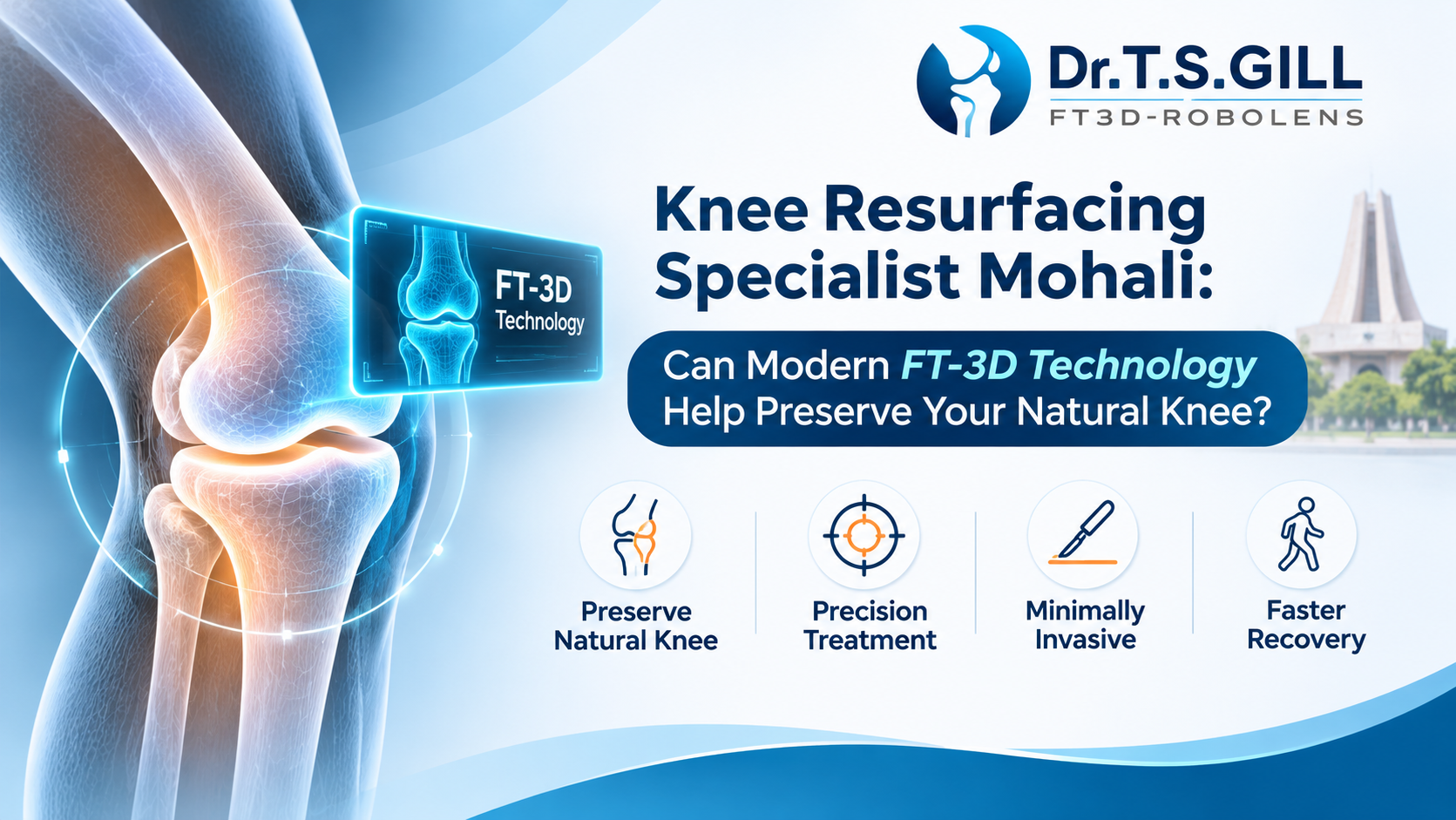
One of the important developments in modern orthopaedics is robotic-assisted surgical planning. Dr. TS Gill uses RoboLens FT3D technology to support precision-based knee resurfacing.
Unlike systems that depend on pre-operative CT scans, the FT3D approach uses intraoperative imaging and tracking to create a three-dimensional understanding of the knee during surgery.
Here is how this technology helps:
- Real-Time 3D Mapping: During the process, the system builds a three-dimensional model of the patient’s knee.
- Precision Planning: The surgeon can assess bone anatomy and plan implant positioning according to individual requirements.
- Bone Preservation: Suitable patients can undergo treatment that preserves healthy portions of the knee.
- Personalized Implant Placement: Implant positioning is planned according to the patient’s anatomy and joint mechanics.
- No Pre-operative CT Scan: The technique does not require a pre-operative CT scan for its mapping process.
For patients exploring FT-3D knee resurfacing Chandigarh, understanding the technology and its potential benefits is an important first step before considering surgery.
Who Can Benefit from Knee Resurfacing?
Not every person with knee arthritis is a suitable candidate for resurfacing. A detailed orthopaedic evaluation is necessary before recommending surgery.
You may be considered for this procedure if:
- Arthritis is limited to one or two knee compartments.
- Your knee pain continues despite physiotherapy, medication or other conservative treatments.
- Important supporting ligaments, particularly the ACL, are functional.
- Your bone quality and overall joint condition are suitable.
- You want to explore a treatment that preserves healthy knee structures.
For advanced arthritis affecting all three compartments, total knee replacement may be more appropriate.
An experienced Knee resurfacing specialist Mohali can assess X-rays, joint movement, ligament stability and your medical history before recommending the right approach.
Why Consult Dr. TS Gill for Advanced Knee Care?
Dr. Tarandeep Singh Gill is an orthopaedic and joint replacement specialist with over 15 years of experience and more than 6,000 joint replacement surgeries performed.
He has received fellowship training in Germany in arthroplasty and arthroscopy and specializes in robotic knee replacement, RoboLens FT3D resurfacing, hip replacement and complex revision surgeries.
His treatment approach focuses on understanding the patient’s condition before recommending surgery. Not every knee problem requires an operation, and conservative treatment may be appropriate in many cases.
Patients considering FT-3D knee resurfacing Chandigarh can consult Dr. Gill to understand the procedure, expected recovery and available alternatives.
What Should You Expect After Knee Resurfacing?
Recovery varies according to the procedure, individual health and rehabilitation progress. Many patients begin assisted walking early under medical supervision.
Physiotherapy plays an important role in regaining strength, improving flexibility and restoring confidence while walking. Your surgeon will provide instructions regarding exercises, wound care and follow-up appointments.
Remember, successful treatment involves more than the surgical procedure. Consistent rehabilitation and regular medical follow-ups are equally important.
Frequently Asked Questions (FAQs)
1. Is knee resurfacing better than total knee replacement?
Neither procedure is universally better. Resurfacing may be suitable when arthritis affects limited compartments, while total replacement is generally considered for widespread joint damage.
2. Does FT3D knee resurfacing require a CT scan?
The RoboLens FT3D mapping technique uses intraoperative imaging and does not require a pre-operative CT scan for surgical mapping.
3. How long does recovery take after knee resurfacing?
Recovery differs between patients. Walking may begin early with assistance, while strength and mobility improve gradually through rehabilitation.
4. How do I know if I need knee resurfacing or total knee replacement?
An orthopaedic examination, X-rays and assessment of ligament stability help determine which procedure is appropriate.
Conclusion
Living with knee arthritis does not automatically mean that the entire knee needs replacement. Depending on the extent of joint damage, knee resurfacing may offer a bone-preserving option for suitable patients.
If you are searching for an experienced Knee resurfacing specialist Mohali, Dr. TS Gill offers advanced orthopaedic evaluation and RoboLens FT3D technology at Max Super Speciality Hospital, Mohali. A consultation can help you understand whether FT-3D knee resurfacing Chandigarh is appropriate for your condition and which treatment approach can best support your mobility.
NAP Details – Dr. TS Gill
Doctor: Dr. T. S. Gill
Address: MAX SUPER SPECIALITY HOSPITAL
3RD FLOOR, NEW BLOCK B
PHASE 6, (SECTOR 56)
MOHALI, CHANDIGARH TRICITY
PUNJAB, INDIA
Phone: +91-82880 15106+91- 62395 89197
Website: https://tsgillortho.com/
Instagram : https://www.instagram.com/drtarandeepsingh