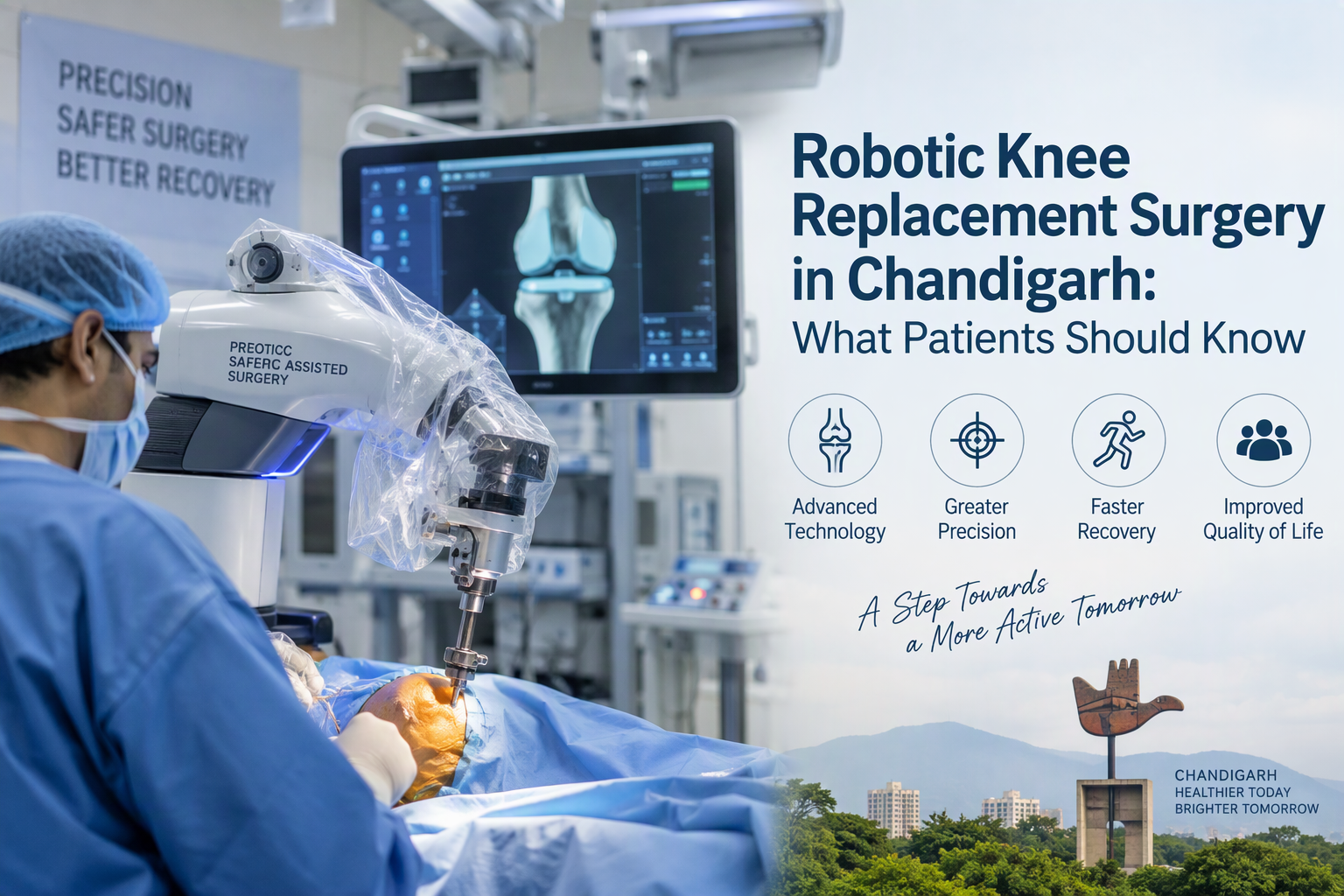
If you have been living with knee pain for years, you already know how it quietly rearranges your life. You skip the stairs. You say no to the family function that involves a lot of walking. You sit through the morning walk in the park from a bench instead of the track. Many people put up with this far longer than they should, partly because the words “knee replacement” sound frightening.
The good news is that knee replacement today looks very different from what your neighbour or an elderly relative may have gone through twenty years ago. Robotic knee replacement surgery in Chandigarh is now an option for patients who want more precision, and in this blog we will walk through what it actually involves, in plain language.
When Does a Knee Need to Be Replaced?
Not every painful knee needs surgery. Most doctors will first try the simpler routes: pain medicines, physiotherapy, weight management, walking aids, and sometimes injections. Replacement is usually discussed when these stop helping.
You may want to speak to an orthopaedic surgeon if:
- Pain continues even at rest or wakes you at night
- Walking short distances, climbing stairs or getting up from a chair has become difficult
- Your knee looks bent, bowed or swollen, and the shape has changed over time
- X-rays show that the cartilage is badly worn out, which is common in advanced osteoarthritis
- Medicines give only short relief, or you are needing them more and more
Only an examination and imaging can tell you what stage your knee is at. Please do not decide this from a blog post, ours included.
What Is Robotic Total Knee Replacement?
In a total knee replacement, the damaged surface of the thigh bone and shin bone is removed and replaced with an artificial implant made of metal and medical-grade plastic. The aim is a joint that moves smoothly and without pain.
Robotic total knee replacement in Chandigarh follows the same basic idea, but with one important difference. The surgeon uses a robotic-assisted system as a tool during the operation. To be clear, the robot does not operate on its own. The surgeon plans the procedure, controls every step, and makes the decisions. The technology helps the surgeon carry out that plan with greater accuracy.
How Does the Robotic Process Work?
While details can differ depending on the system a hospital uses, the general journey looks like this.
1. Planning. Your surgeon studies your knee through scans or by mapping the joint, so the plan is based on your own anatomy rather than an average one.
2. Measuring during surgery. The system records details such as the alignment of your leg and the balance of the ligaments around the knee.
3. Guided bone preparation. The surgeon removes only the amount of bone that the plan calls for, working within boundaries set beforehand. This helps in placing the implant at the angle and position that suits your knee.
4. Final checks. Before the operation finishes, the surgeon checks how the knee bends, straightens and feels stable.
The idea behind all this is simple. A knee that is positioned and balanced well tends to feel more natural, and the implant is more likely to wear evenly.
Possible Benefits of Robotic Knee Replacement
Patients and surgeons often talk about the following advantages:
- Better precision in cutting bone and placing the implant
- Personalised planning, since every knee is slightly different
- Less disturbance to healthy tissue, which may mean less pain after surgery for some patients
- Better balance of the soft tissues around the joint
- A smoother start to rehabilitation for many patients
It is fair to say that results depend on many things: your age, bone quality, how severe the deformity is, your general health, and the skill of your surgical team. Robotic technology supports a good surgeon. It does not replace one, and it cannot promise a perfect outcome to anyone.
What Is Recovery Like?
Every patient heals at their own pace, but a typical path goes like this.
- The first day or two: Most patients are encouraged to stand and take a few steps with support very early, often within a day. Early movement lowers the risk of stiffness and blood clots.
- The first few weeks: Physiotherapy becomes your daily routine. Exercises focus on bending, straightening and strengthening the knee. Some swelling and discomfort is normal.
- Around six weeks: Many people are back to light daily activities and walking comfortably.
- Three months and beyond: Strength and confidence keep improving, and the knee continues to settle for up to a year.
The most important thing you can do for your recovery is to follow your physiotherapy plan honestly, even on the days you do not feel like it.
Questions to Ask Your Surgeon
Before you decide, it helps to walk into the consultation with a short list.
- Do I really need a replacement right now, or can other treatments still help me?
- Am I a good candidate for robotic surgery, or would a conventional approach suit me better?
- How many knee replacements has the surgeon performed?
- What implant will be used, and why is it right for me?
- What are the risks in my particular case?
- What will recovery look like, and when can I return to work and daily routine?
- What is the total expected cost, and what does it include?
A good surgeon will welcome these questions. If someone seems uncomfortable answering them, take that as information.
Why Patients Look for Robotic Knee Surgery in Chandigarh
Chandigarh and the surrounding region, including Mohali and Panchkula, have become a convenient hub for advanced orthopaedic care. For families living in Punjab, Haryana, Himachal and nearby areas, it means access to modern surgical options without travelling to a metro city far away. Being close to home also matters during recovery, because follow-up visits and physiotherapy are much easier when you do not have to travel long distances.
At ARV Hospital, the focus is on explaining your options honestly and recommending what is genuinely right for your knee. Sometimes that is surgery, and sometimes it is not.
Frequently Asked Questions
Is robotic knee replacement painful? Some pain after any major surgery is expected, but modern pain control methods keep it manageable. Many patients are surprised at how early they are able to walk.
How long do robotic knee implants last? Modern implants are designed to last many years, often 15 to 20 years or more, depending on your weight, activity level and how well the implant is positioned.
Is the robot doing the surgery? No. The surgeon is in control throughout. The robotic system is a guidance tool.
How long will I stay in the hospital? Most patients stay for a few days, depending on their health and how quickly they begin walking.
Is it suitable for both knees? Yes, in many cases both knees can be treated, either together or in stages. Your surgeon will advise what is safest for you.
Is it suitable for older patients? Age alone is not a barrier. What matters more is your overall health and fitness for surgery.
Final Thoughts
Knee pain does not have to be something you simply accept as part of growing older. If everyday movement has become a struggle, a proper evaluation is the first step, and it does not commit you to anything. For many people, robotic total knee replacement in Chandigarh offers a precise, carefully planned way to get back to walking, climbing stairs and enjoying life with less pain.
If you or someone in your family is dealing with persistent knee pain, you are welcome to visit ARV Hospital, get your knee examined, and decide with full information.
Book a consultation with ARV Hospital today to find out whether robotic knee replacement is right for you.
Contact ARV Hospital
ARV Orthopaedic Hospital
Address: #2125, Sarovar Path, Sector 21C, Chandigarh, 160022
Open: 24×7 hrs
Phone: 0172 400 5596, 271 1978, 8427452125
Email: dratulmalhotra.23@gmail.com
Connect With Us
Facebook: https://www.facebook.com/ARVHospital