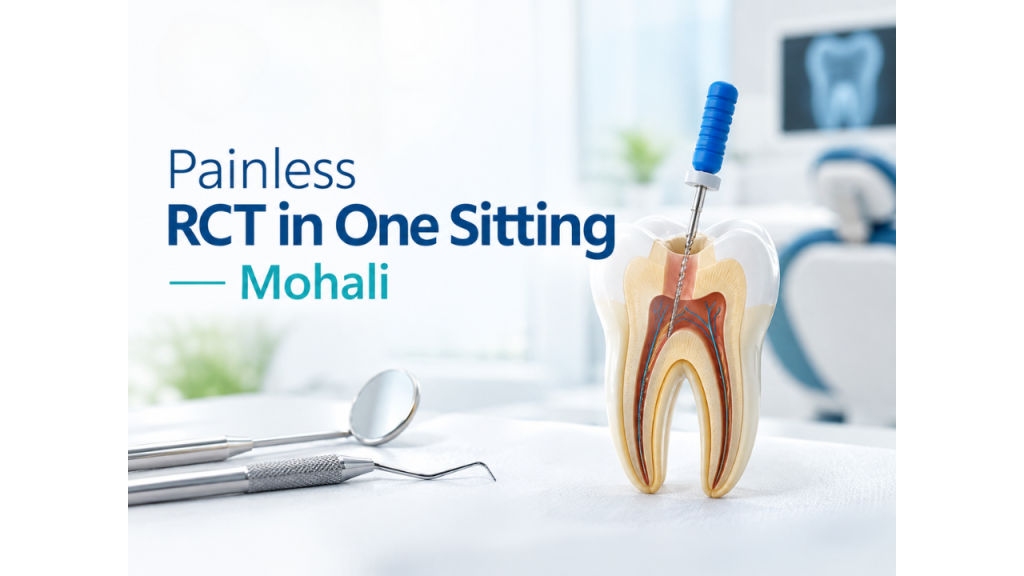
Tooth infections can make simple tasks like eating and sleeping uncomfortable. If the nerve of a tooth becomes infected or starts to break down, it can lead to an abscess. One possible treatment to avoid extracting the tooth is called a root canal treatment. Root canals are done to remove the infected or broken-down nerve of the tooth. Root canals are usually less comfortable treatment compared to extractions; however, with proper local anesthesia and experience with Root canals, most patients report little to no discomfort during the treatment.
For patients searching for Painless RCT in one sitting in Mohali, the description of the treatment and what to expect during the procedure helps to understand the procedure and gives a sense of comfort to help alleviate any fears about the treatment.
What is Root Canal Treatment?
Root canal treatment is also known as RCT. An RCT is a treatment to remove the infection or inflammation of the nerve of a tooth. A tooth consists of root canals. To complete a root canal treatment the dentist removes the infection of the nerve of the tooth and also the infection of the canals of the tooth. After the canals are cleaned of the infection, the canals are sealed.
If the condition of a tooth is appropriate, an RCT can be completed in a single visit.
What is Painless RCT?
Painless Root canals are Root canals that are completed with proper local anesthesia. With proper local anesthesia, and with experience, a root canal treatment should be comforting to the patient.
Although, some patients may feel pressure or other sensations during a root canal, patients should not feel sharp or acute pain during a root canal.
It is recommended that you consult with a dentist if you are in need of a painless root canal treatment in Mohali.
Can Root Canal Treatment (RCT) Be Done in One Visit?
It is possible to do a RCT in one visit, and for certain cases, this is appropriate. In general, however, the decision to perform RCT in multiple visits is based on many factors.
For example, a tooth can have an unusual or very complex shape (anatomy) and it may also have more than one canal. Furthermore, the tooth may have swelling which can cause an infection. If the tooth has an infection, it may also be infected in the surrounding bones.
If any of these are present, then it may take more than one visit to completely cleanse the infection.
It is important to understand that just because a dentist states that RCT can be done in one visit, it doesn’t mean that other visits to examine the tooth and surrounding tissues and take x-rays, if needed, should be skipped.
What Are The Advantages of Doing Root Canal Treatment (RCT) in One Visit?
If RCT can be completely done in one visit, it has several advantages.
First, it saves time.
Second, since the infection is removed, and the treatment retains the natural tooth, the tooth can be used to perform normal functions like chewing.
Third, it reduces the number of visits to the dentist.
Finally, it is quicker to perform RCT due to advances in dental equipment and the skills and training of the dentists.
Who Needs Root Canal Treatment (RCT)?
RCT is indicated when a tooth infection becomes severe. Often, this occurs when the infection is very deep within the tooth due to a large cavity, or the tooth has been damaged due to an impact or has an excessive crack. Repeated dental procedures on the same tooth can also lead to the infection spreading.
Symptoms of an infection of the tooth can include:
- Persistent toothache
- Tooth sensitivity to hot or cold
- Tooth sensitivity to cold
- Pain when chewing
- Swelling
- Discoloration of the tooth
However, an infection of the tooth may not always present with symptoms.
If you’ve been searching for single sitting RCT near me and have only your symptomatic tooth/teeth examined, then you should also get your asymptomatic tooth/teeth examined.
After RCT, it is normal to have tenderness and mild discomfort while chewing.
Your dentist may also advise you not to floss or chew on the side of the treated tooth/teeth until it/they has/have fully recovered and the final restoration has/have been done. This is to prevent additional stress on the tooth.
It is also advisable to continue regular dental check ups.
FAQ
How painful is root canal treatment?
As the area to be treated is first numbed, you should not feel anything more than pressure during the treatment.
Can all RCT be completed in one sitting?
Not all cases of RCT can be completed in a single sitting. The dentist will decide on the case to case basis.
How long does a single sitting RCT take?
It may take single sitting rct near me between 1 to 3 hours depending on the complexity of the treatment required.
Is a crown necessary after RCT?
A crown may be recommended after RCT as a restoration to protect the tooth from fracturing. The type of restoration to be placed on the tooth is determined by the condition of the tooth and other surrounding teeth.
How is RCT decided?
If there are signs and symptoms such as pain of the tooth, sensitivity of the tooth, swelling and difficulty in chewing with that tooth then then it calls for an evaluation by a dentist. Only a thorough examination by a dentist and necessary x-rays can help reach a diagnosis.
About Us
Business Name: The Smile Atelier
Address: 2nd Floor, SCO 36, Jubilee Junction, Sec-66, Mohali, Punjab, India
Phone:9-115-115-900
Website: https://thesmileatelier.in/
Consistency is important. Repeating your business name, address, phone number and hours of operation across the web makes it easier for potential patients to locate you.
Finally,
The aim of a root canal treatment is to remove infection from the root canal system of the tooth and retain the tooth in the mouth. This treatment is carried out by a specialized dentist. For patients looking for painless rct in one sitting mohali, keeping the complexity of the case and the experience level of the dentist in mind, the treatment can be rendered comfortable. Patients searching for a single sitting rct near me should also understand that treatment suitability depends on the individual condition of the tooth. However, it should be kept in mind that a promise of treatment within a particular time frame should not be the deciding factor when choosing the right treatment.